

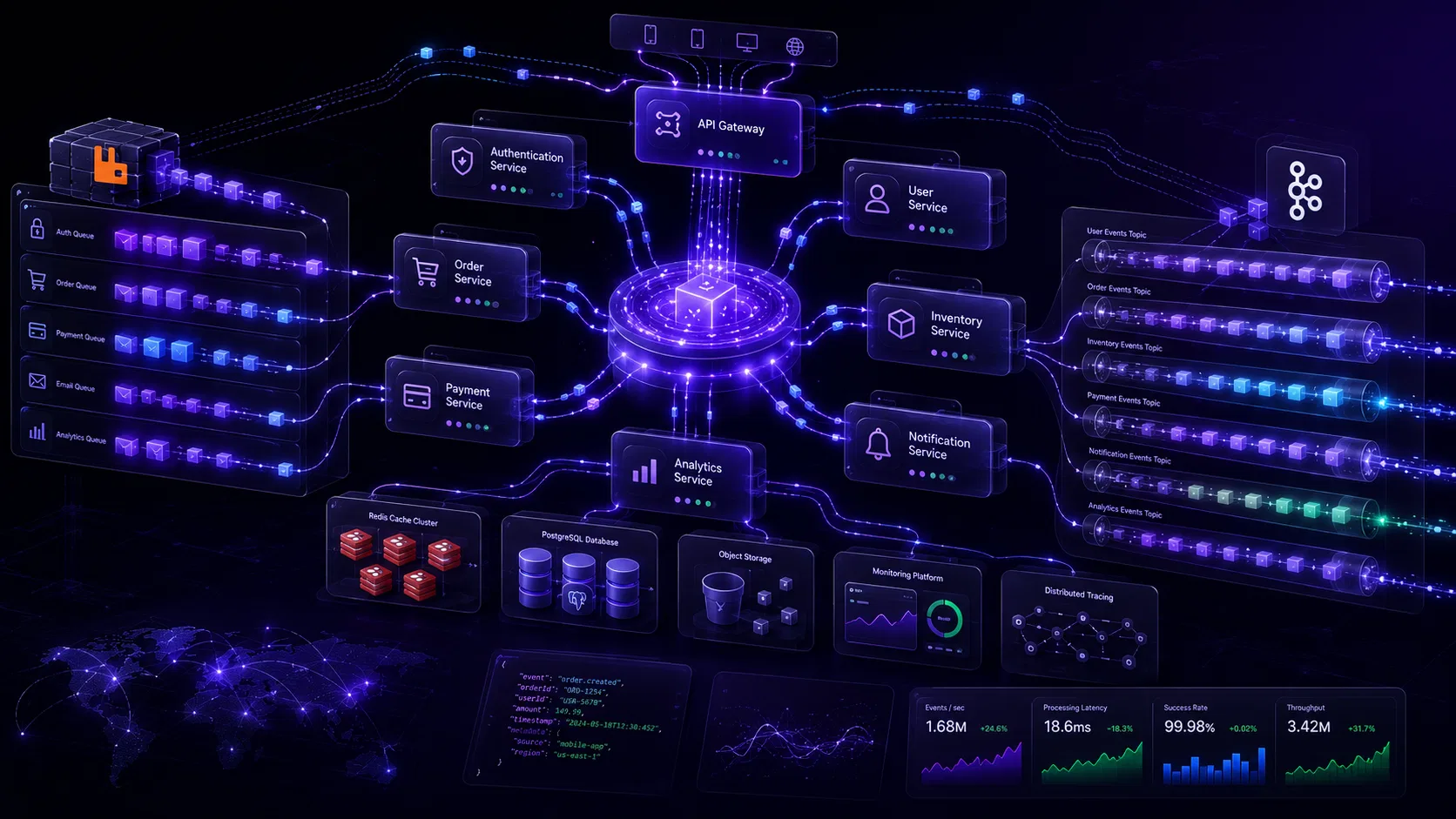
As applications grow, tightly coupled services become increasingly difficult to maintain. Event-driven architecture enables systems to communicate asynchronously, improving scalability, resilience, and flexibility. This article explains how modern distributed applications leverage events to handle high-volume workloads efficiently.
What you'll learn:
- 📡 Fundamentals of event-driven architecture
- ⚙️ Events, producers, consumers, and message brokers
- 📨 RabbitMQ vs Kafka: choosing the right messaging platform
- 🔄 Designing reliable asynchronous workflows
- 🛡 Handling failures, retries, and dead-letter queues
- 📊 Observability and monitoring for distributed systems
Key Insights
📡 Events Reduce Coupling
Services communicate through events instead of direct dependencies, making systems easier to evolve independently.
⚙️ Reliability Requires Planning
Retries, idempotency, message ordering, and failure recovery are essential parts of production-ready event-driven systems.
📨 Choose the Right Broker
RabbitMQ excels at traditional messaging and task queues, while Kafka is optimized for high-throughput event streaming and analytics.
🔄 Asynchronous Processing Improves Scale
Background processing keeps applications responsive while handling resource-intensive workloads efficiently.
📊 Visibility Matters
Distributed systems require centralized logging, tracing, and monitoring to understand message flow and diagnose failures.
Key Takeaways
- Event-driven systems improve scalability and resilience.
- Design events as stable business contracts rather than implementation details.
- Implement retries, dead-letter queues, and idempotency for reliability.
- Choose RabbitMQ or Kafka based on workload requirements.
- Invest in observability before deploying distributed systems.
- Asynchronous workflows improve both performance and user experience.
- Keep services loosely coupled and independently deployable.